Last Updated: January 2026 · 9 min read · Written for developers considering Germany or already working there
Germany is one of Europe's top destinations for software engineers — but the gap between your gross salary and what actually lands in your bank account can be a shock if you are not prepared. A €75,000 gross salary in Berlin does not mean €6,250 a month. After Lohnsteuer, health insurance, pension contributions, and nursing care insurance, you are likely taking home closer to €3,800–€4,000.
This guide explains exactly how German payroll deductions work in 2026, breaks down net salaries by experience level and city, and shows you how to use Paylio's Germany software engineer salary calculator to model your exact situation in under 60 seconds.

Software engineer salaries in Germany 2026: gross vs net by level
The table below shows typical gross salaries for software engineers at each career level in Germany, along with estimated monthly net pay. All figures use Steuerklasse I (single, no church tax) as the baseline — the most common situation for expats and international hires.
| Level | Gross / yr | Gross / mo | Net / mo | Tax rate | Tax €/mo |
|---|---|---|---|---|---|
| Junior (0–2 yrs) | €45,000 | €3,750 | €2,260 | 39.6% | €1,490 |
| Mid-level (3–5 yrs) | €65,000 | €5,417 | €3,330 | 38.5% | €2,087 |
| Senior (6–10 yrs) | €85,000 | €7,083 | €4,215 | 40.5% | €2,868 |
| Lead / Staff | €105,000 | €8,750 | €4,980 | 43.1% | €3,770 |
| Principal / VP Eng | €130,000 | €10,833 | €5,830 | 46.2% | €5,003 |
Note: Net figures are calculated using 2026 tax rates, Steuerklasse I, no church tax, average health insurance add-on contribution of 1.7%, West Germany pension ceiling. Use Paylio's calculator on this page for your exact figures.
What gets deducted from your Germany developer salary?
Germany's payroll system is complex because deductions are split between mandatory social contributions (Sozialabgaben) and income tax. Both are calculated separately, then combined on your payslip. Here is every deduction a software engineer in Germany faces in 2026:
| Deduction | Rate | Notes for software engineers |
|---|---|---|
| Income tax (Lohnsteuer) | Depends on tax class | Biggest variable — Steuerklasse I vs III can differ by €300–500/mo. |
| Solidarity surcharge (Soli) | 0% for most in 2026 | Abolished for most earners; applies only above ~€136k. |
| Pension insurance (RV) | 9.3% employee share | Capped at €7,550/mo gross (West Germany 2026). |
| Health insurance (KV) | 7.3% + add. contribution | Add. avg 1.7% — so ~9.0% total; varies by Krankenkasse. |
| Unemployment insurance (AV) | 1.3% employee share | Flat rate, capped at same ceiling as pension. |
| Nursing care insurance (PV) | 1.7% (+ 0.6% if no kids) | Higher if you have no children — often overlooked. |
| Church tax (Kirchensteuer) | 8–9% of income tax | Optional — only if registered in a church. |
The total deduction rate for a mid-level software engineer earning €65,000 gross is typically 38–42%. At senior level (€85,000+), this creeps up to 40–45% as income tax progresses faster than the social contribution caps.
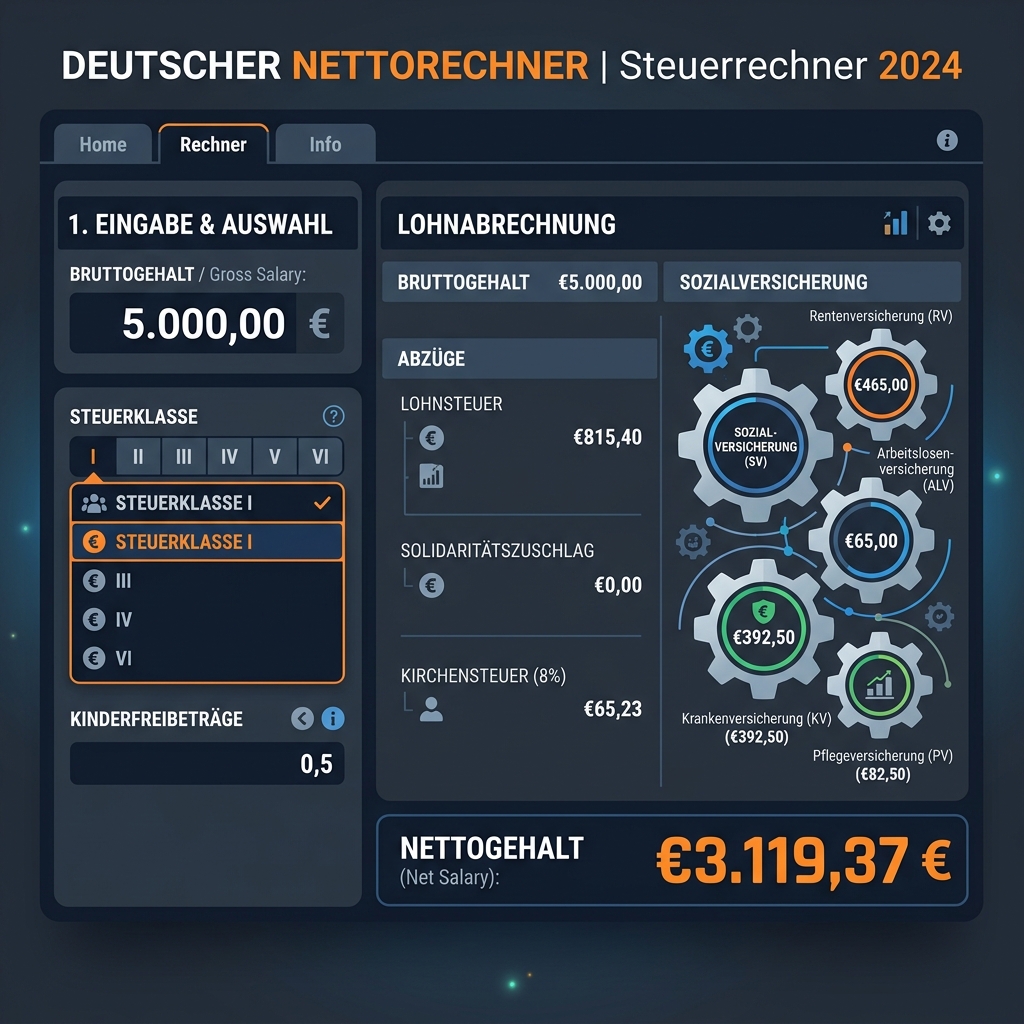
Calculate your exact net salary — Paylio's free tool
Rather than using generic estimates, you can calculate your precise net salary in under 60 seconds using Paylio's Germany salary calculator. Use the interactive calculator tool on the left side of the page (or scroll up on mobile devices) to simulate:
- Your exact gross salary and employment type
- Steuerklasse (tax class) — a critical variable many calculators ignore
- Church tax (Kirchensteuer) if applicable
- Your specific Krankenkasse's additional health insurance contribution
- West vs East Germany pension ceiling differences
- 2026 updated tax tables and social contribution rates
Net salary by city: Berlin vs Munich vs Hamburg vs Frankfurt
Where you work in Germany significantly affects your real disposable income — not because the income tax is different (it is federal and uniform), but because rent, cost of living, and salary benchmarks vary dramatically between cities. Here is how the numbers compare for a senior software engineer on €85,000 gross:
| City | Typical gross | Net/mo (Est) | Avg rent (1BR) | Real disposable |
|---|---|---|---|---|
| Berlin | €75k–€110k | €3,790–€5,160 | €1,300 | €2,490–€3,860 |
| Munich | €85k–€125k | €4,215–€5,640 | €1,800 | €2,415–€3,840 |
| Hamburg | €75k–€110k | €3,790–€5,160 | €1,400 | €2,390–€3,760 |
| Frankfurt | €80k–€120k | €4,005–€5,460 | €1,500 | €2,505–€3,960 |
| Stuttgart | €75k–€115k | €3,790–€5,310 | €1,200 | €2,590–€4,110 |
| Remote (Germany) | €65k–€100k | €3,330–€4,780 | €800–€1,100 | €2,230–€3,980 |
Key insight: Munich pays the highest salaries but has the highest rents, leaving less disposable income than Stuttgart or a remote role. Remote-first roles with a Berlin or Hamburg salary band but lower living costs (smaller German cities or abroad) are increasingly the best financial choice for senior engineers.
Steuerklasse explained: the tax class that changes everything
Your Steuerklasse (tax class) is one of the most impactful — and least understood — variables in your German net salary. It can mean a difference of €400–600 per month on the same gross salary. As an expat or new arrival in Germany, you are automatically assigned Steuerklasse I unless you register otherwise.
| Class | Who it applies to | What it means | Net/mo example (€65k gross) |
|---|---|---|---|
| I | Single, divorced, widowed | Standard deductions. Default for most expats. | €3,372/mo |
| II | Single parent | Higher tax-free allowance than Class I. | €3,520/mo |
| III | Married, higher earner | Lowest deductions — best net for primary earner. | €3,850/mo (+€478 vs I) |
| IV | Married, both work (equal earnings) | Both partners use same class. | €3,372/mo |
| V | Married, lower earner | Higher deductions — partner uses Class III. | €2,890/mo |
| VI | Second job | Highest deductions — no tax-free allowances applied. | Lowest Net |
Action point for expat couples: If you and your partner both work in Germany and one of you earns significantly more, switching to Steuerklasse III/V can increase the higher earner's monthly net pay by €400–600. Apply through your Finanzamt (local tax office) using the Steuerklassenwechsel form. It can be done once per year.

Germany software engineer salary: how does it compare to other European tech hubs?
Germany offers strong gross salaries for software engineers, but the tax burden is higher than in some competing markets. Here is how a senior software engineer's net position compares across Europe in 2026:
- Germany (Berlin, €85k gross): ~€4,215/mo net · High taxes, excellent benefits, strong job security.
- Netherlands (Amsterdam, €85k gross): ~€4,550/mo net · Expat 30% ruling available for first 5 years.
- Spain (Barcelona, €85k gross + Beckham Law): ~€5,300/mo net · 24% flat tax for qualifying expats. See our Beckham Law Guide for details.
- Switzerland (Zurich, CHF 130k gross): ~CHF 8,000/mo net · Lower taxes, but much higher cost of living.
- UK (London, £80k gross): ~£4,200/mo net · High London rents offset salary.
- Poland (Warsaw, €55k gross): ~€2,900/mo net · Much lower cost of living offsets lower gross wages.
Germany's proposition is stability, visa clarity, strong labour protections, and access to a large tech ecosystem — not necessarily the highest net salary. For maximising take-home pay in Europe, Spain's Beckham Law or the Netherlands' 30% ruling are worth investigating if you qualify.
How to get a higher net salary as a software engineer in Germany
Your gross salary is negotiable. Your tax class, once optimised, is largely fixed. But there are several legitimate strategies software engineers use in Germany to increase their effective net compensation:
1. Negotiate non-cash benefits (Sachbezüge)
Germany allows up to €50/month in tax-free non-cash benefits per employee. Common examples: public transport tickets (Deutschlandticket), gym memberships, meal vouchers, or fuel cards. On €600/year tax-free, that is worth ~€250/year extra for a senior engineer — ask your employer to formalise this.
2. Optimise pension contributions via employer matching
Ask your employer for bAV (betriebliche Altersvorsorge — company pension) contributions above the mandatory minimum. Employer-side bAV contributions reduce your taxable salary, lowering your Lohnsteuer without reducing your take-home pay.
3. Home office deduction (Arbeitszimmer)
Since the pandemic-era reforms, German employees working from home can deduct €6 per home office day from their taxable income, up to €1,260/year (210 days). If you work hybrid or fully remote, claim this in your annual tax return (Steuererklärung). Many engineers leave this unclaimed.
4. Switch to freelance (Freiberufler) for the right roles
Senior software engineers can significantly increase their gross hourly rate by operating as a Freiberufler. Rates of €90–150/hour are common for experienced developers in Germany. The trade-off: no employer benefits, full social contributions on your side, and quarterly Vorauszahlungen (advance tax payments). Use Paylio's German freelancer calculator to model the net difference.
What does a German software engineer payslip actually look like?
Using a mid-level software engineer earning €65,000 gross in Berlin (Steuerklasse I, public health insurance, no church tax, no children):
- Gross monthly salary: €5,416.67
- Lohnsteuer (income tax): €892.00
- Solidarity surcharge (Soli): €0.00 — below threshold in 2026
- Pension insurance (RV, 9.3%): €503.75
- Health insurance (KV, 7.3% + 1.7% add.): €487.50
- Unemployment insurance (AV, 1.3%): €70.42
- Nursing care insurance (PV, 1.7%): €92.08
- Total deductions: €2,045.75
- Net take-home: €3,370.92 / month
These are the figures Paylio's calculator produces for this exact scenario. Try it with your own salary to see your personalised payslip breakdown.
Related calculators: Germany Tax Calculator (all roles) · Berlin Income Tax Calculator · Compare Salaries Across Europe