Table of Contents
- 1. What is the Beckham Law?
- 2. Who qualifies for the Beckham Law in 2026?
- 3. The digital nomad visa exception
- 4. Beckham Law tax rates 2026
- 5. Beckham Law calculator 2026: see your real savings
- 6. How to apply for the Beckham Law: step-by-step
- 7. How long does the Beckham Law last?
- 8. What the Beckham Law does NOT cover
- 9. Common mistakes expats make
- 10. Beckham Law vs standard Spanish tax
- 11. Frequently asked questions
Moving to Spain on a high salary? You could be paying dramatically less tax than your Spanish colleagues — legally. The Beckham Law (officially the Régimen Especial de Impatriados) allows qualifying foreign workers to pay a flat 24% income tax rate instead of Spain's standard progressive rates, which climb as high as 47%.
In this guide, we break down everything you need to know about the Beckham Law in 2026: who qualifies, how much you can save, and how to use Paylio's free calculator to model your exact net salary before you sign that relocation contract.

1. What is the Beckham Law (Régimen Especial de Impatriados)?
The Beckham Law takes its nickname from footballer David Beckham, who famously used this tax regime when he moved to Real Madrid in 2003. Since then, it has become one of the most attractive tax incentives for high-earning professionals relocating to Spain.
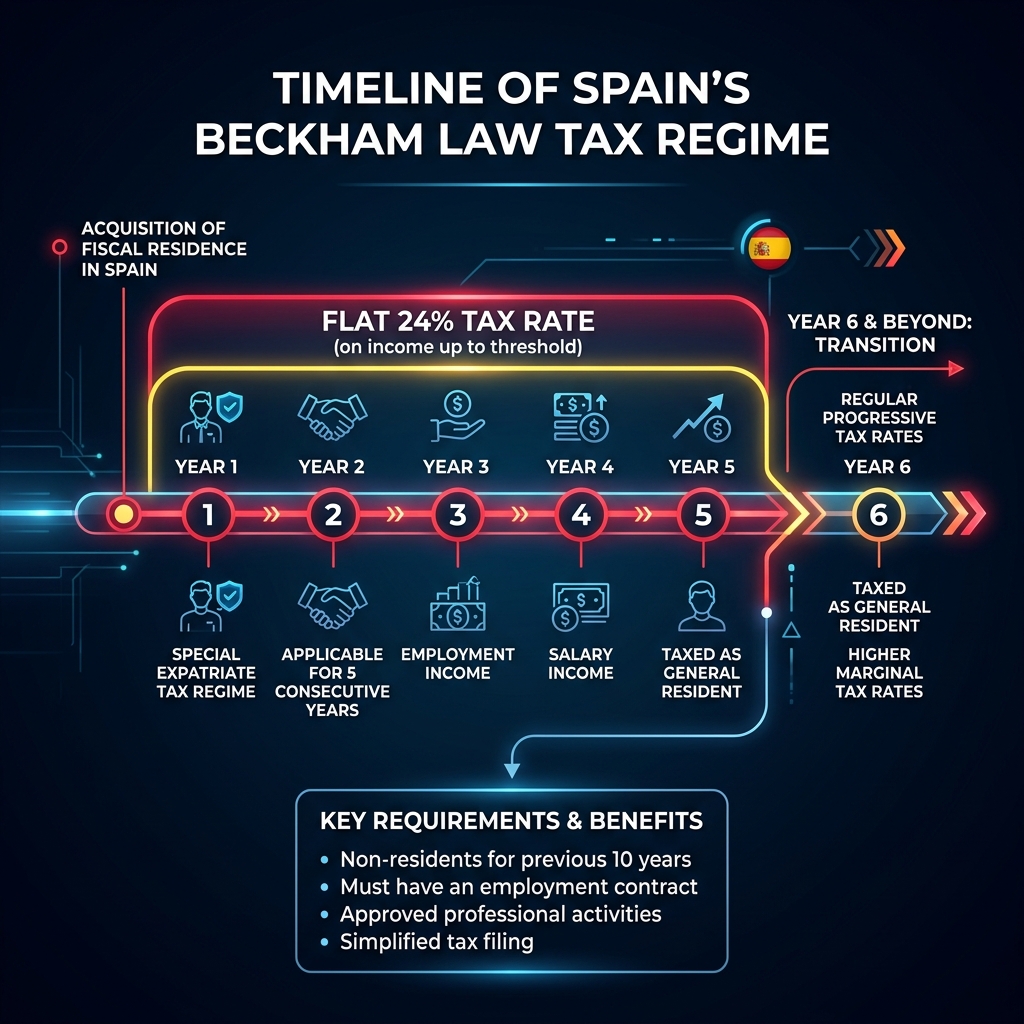
Formally known as the Régimen Especial para Trabajadores Desplazados a Territorio Español (Special Regime for Workers Displaced to Spanish Territory), this regime allows qualifying individuals to be taxed as non-residents for up to six years, even while living and working in Spain full-time.
The key benefit: instead of paying Spain's progressive income tax (IRPF) — which rises to 45% above €60,000 and 47% above €300,000 — you pay a flat 24% on employment income up to €600,000. Income above that threshold is taxed at 47%.
2. Who qualifies for the Beckham Law in 2026?
The eligibility criteria were updated in recent years, including for digital nomad visa holders. In 2026, you qualify if you meet all of the following conditions:
| You qualify if... | You do NOT qualify if... |
|---|---|
| ✓ You have a Spanish work contract | ✗ You were a Spanish tax resident in the past 5 years |
| ✓ You were non-resident in Spain for 5+ years | ✗ You are self-employed (autónomo) — post-2023 exception: digital nomad visa |
| ✓ You apply within 6 months of starting work in Spain | ✗ You apply after the 6-month deadline |
| ✓ Your income exceeds €600,000 (still eligible at 24% up to that threshold) | ✗ Your employer is not registered in Spain (with some exceptions) |
3. The digital nomad visa exception (2026 update)
Since 2023, Spain's Digital Nomad Visa holders can also access the Beckham Law regime — even if they are technically self-employed (autónomo) or work for foreign companies. This is a significant expansion of the original rules and makes Spain even more attractive for remote workers earning abroad.
4. Beckham Law tax rates 2026: the 24% flat rate explained
Here is how the Beckham Law rate compares to Spain's standard IRPF progressive brackets in 2026:
| Income bracket | Standard IRPF rate | Beckham Law rate |
|---|---|---|
| Up to €12,450 | 19% | 24% |
| €12,450 – €20,200 | 24% | 24% |
| €20,200 – €35,200 | 30% | 24% |
| €35,200 – €60,000 | 37% | 24% |
| €60,000 – €300,000 | 45% | 24% |
| Over €600,000 | 47% | 24% (up to €600k) + 47% above |
As the table makes clear, the Beckham Law is especially valuable for anyone earning above €35,200 per year. At that level, standard IRPF rates jump to 37% and above — while Beckham Law taxpayers continue paying just 24% on every euro up to €600,000.
Calculate Your Spain Salary
Estimate your take-home pay under standard or Beckham Law tax configurations with our Spain Calculator.
5. Beckham Law calculator 2026: see your real savings with Paylio
The easiest way to understand your personal tax saving is to run the numbers. Paylio's Spain salary calculator lets you toggle between standard employment and Beckham Law regime, giving you an instant side-by-side comparison of your net take-home pay.
| Gross salary | Net (standard tax) | Net (Beckham Law) | Annual saving |
|---|---|---|---|
| €60,000 | €37,800 | €42,600 | €4,800 / year |
| €80,000 | €48,200 | €56,800 | €8,600 / year |
| €100,000 | €57,000 | €71,200 | €14,200 / year |
| €150,000 | €77,400 | €108,000 | €30,600 / year |
| €200,000 | €97,800 | €144,000 | €46,200 / year |
Note: These are estimates for illustrative purposes. Social security contributions, regional surcharges, and individual deductions will affect your exact net salary. Use Paylio's calculator for a precise figure based on your situation.
6. How to apply for the Beckham Law in 2026: step-by-step
Applying for the Beckham Law is time-sensitive. You must submit your application within six months of your Spanish work start date. Missing this window means you cannot access the regime for that posting, regardless of how well you qualify.
- Register with the Spanish tax authority (Agencia Tributaria) and obtain your NIE (Número de Identificación de Extranjero)
- Complete Form 149 (Modelo 149) — this is the official Beckham Law application form
- Submit within 6 months of your first day of work in Spain
- Receive your approval certificate from the Agencia Tributaria (typically within 10 working days)
- Notify your employer so they apply the correct 24% withholding rate on your payslips
- File your annual tax return using Form 151 (Modelo 151) — not the standard Modelo 100
Pro tip: Many expats work with a Spanish gestor (tax advisor) to handle the application. The cost is typically €300–600 and pays for itself on day one given the tax savings involved.
7. How long does the Beckham Law last? The 6-year rule
The Beckham Law applies for the tax year in which you arrive in Spain plus the following five tax years — a total of up to six years. After that period, you become a standard Spanish tax resident and your income is taxed at the regular progressive IRPF rates.
This means planning your finances around the end of the regime is important. Some expats use the sixth year to negotiate salary restructuring, equity vesting schedules, or international assignments before the regime expires.
8. What the Beckham Law does NOT cover
While the savings are substantial, it is important to understand what the regime does not cover:
- Worldwide income is not necessarily exempt. Unlike some other regimes, Beckham Law does not completely exempt foreign-sourced income — it taxes Spanish-source employment income at 24%, but investment income and overseas income may be subject to standard non-resident rates (19–26%).
- Wealth tax (Impuesto sobre el Patrimonio) still applies to Spanish-based assets. However, Beckham Law taxpayers are only taxed on wealth located in Spain, not worldwide — a meaningful advantage for high-net-worth individuals.
- Social security contributions are separate from income tax and are not reduced by the Beckham Law. You will still contribute to Spain's social security system as a standard employee.
- Regional income tax surcharges do not apply under the Beckham Law, since you are taxed as a non-resident at national level only.
9. Common mistakes expats make when applying
After helping thousands of expats model their Spain salary, here are the most frequent errors we see:
- Missing the 6-month application window. This is the single most common and most costly mistake. The deadline is strictly enforced.
- Applying as autónomo before confirming eligibility. Pre-2023, self-employed workers did not qualify. If you are on a digital nomad visa, confirm your specific eligibility with a gestor before registering. We explain self-employed setups in our Autónomo vs Forfettario Freelance tax guide.
- Not informing your employer. Even with an approved Modelo 149, your employer will continue withholding at the standard rate until officially notified. This creates unnecessary cashflow issues and requires a tax refund claim.
- Forgetting to file Modelo 151. Beckham Law taxpayers must file a different annual return (Modelo 151) instead of Modelo 100. Filing the wrong form causes delays and potential penalties.
- Assuming all income is taxed at 24%. Dividends, rental income, and capital gains have different rates. Always model your full income picture.
10. Beckham Law vs standard Spanish tax: real-world comparison
Example: Software engineer, €120,000 gross salary, relocating to Madrid in 2026
- Standard IRPF: approximately €50,400 tax owed → net take-home €69,600
- Beckham Law: approximately €28,800 tax owed → net take-home €91,200
- Annual saving: €21,600 — or €129,600 over the full 6-year regime
This is why the Beckham Law is not just a tax benefit — it is a fundamental factor in negotiating relocation packages. Many international employers in Spain will incorporate the Beckham Law savings into their compensation modelling, since it allows them to offer a competitive net salary at a lower gross cost.
Use Paylio's Spain calculator to model your own scenario across all six years of the regime or compare it to other tech hubs, like Germany in our German vs European tax review.
Ready to calculate your Beckham Law net salary?
Paylio's free Spain salary calculator is updated for 2026 and supports both standard employment and Beckham Law regime modelling.
11. Frequently asked questions — Beckham Law Spain 2026
Can I apply for the Beckham Law if I work remotely for a foreign company?
Yes — since 2023, holders of Spain's Digital Nomad Visa can access the Beckham Law even if they work for a non-Spanish employer or operate as an autónomo. You must still meet the 5-year non-residency requirement and apply within 6 months of arriving in Spain.
Does the Beckham Law apply to my spouse and family?
Your spouse and children under 25 can also apply for the Beckham Law under certain conditions — even if they do not work in Spain themselves. They must file separate applications and meet the residency criteria independently. Family members typically cannot access the income tax benefit unless they have their own qualifying employment.
What happens if I leave Spain before the 6-year period ends?
If you leave Spain before the regime expires, you lose the Beckham Law status from the date of departure. You must notify the Agencia Tributaria and will be taxed as a non-resident for the partial year of departure. No penalties apply for leaving early.
Can I combine the Beckham Law with pension contributions or deductions?
Most standard deductions available to regular Spanish residents do not apply under the Beckham Law. Pension contributions, mortgage deductions, and family allowances are generally not available to Beckham Law taxpayers, since you are treated as a non-resident for tax purposes. This is a trade-off worth factoring into your overall financial planning.
Is the Beckham Law still worth it in 2026 after recent changes?
Yes — despite various adjustments since its introduction, the Beckham Law remains one of the most generous expat tax regimes in Europe. The 24% flat rate on employment income, combined with Spain's improving infrastructure, climate, and quality of life, continues to attract senior executives, tech professionals, and high-income remote workers from across the world.
How do I calculate my exact Beckham Law net salary?
The most accurate way is to use Paylio's Spain salary calculator, which is updated for 2026 tax rules. Enter your gross salary, select 'Beckham Law regime', and the calculator will show your estimated income tax, social security contributions, and monthly net take-home pay. You can also compare side-by-side with standard IRPF rates.