Last Updated: January 2026 · 10 min read · Written for expats moving to or working in Berlin
Berlin is one of Europe's most exciting cities for international talent — but if you have ever tried to understand your German payslip, you know the deduction system is no small thing. A €70,000 gross salary sounds generous until €2,300 disappears every month before you see a cent.
This guide gives you everything you need: the 2026 income tax brackets, a full gross-to-net salary table, a real payslip breakdown, how Steuerklasse affects your take-home, and how to use Paylio's free Berlin income tax calculator to model your exact situation in seconds.
Does Berlin have its own income tax rate?
This is the most common question from expats arriving in Berlin — and the short answer is: no. Germany's income tax (Lohnsteuer) is a federal tax. Whether you work in Berlin, Munich, Hamburg, or Frankfurt, you pay exactly the same national tax rate on the same gross salary.
What does differ by city is the church tax (Kirchensteuer), which in Berlin is 9% of your income tax if you are registered as a church member. But this is optional — deregister from your church (Kirchenaustritt) at any Berlin courthouse for a small fee and you stop paying it immediately.
The reason people search for a 'Berlin income tax calculator' specifically is usually because they are relocating to Berlin and want to understand their local cost of living versus net salary — not because Berlin has special rates. This guide answers both questions.
German income tax brackets 2026: the full breakdown
Germany uses a progressive income tax system. The rates apply to your total annual gross income from employment (your Lohnsteuer base). All amounts are for the 2026 tax year:
| Income bracket | Tax rate | What it means for expats |
|---|---|---|
| Up to €12,096 | 0% | Tax-free basic allowance — nobody pays tax here |
| €12,097 – €17,005 | 14%–24% | Progressive entry zone |
| €17,006 – €66,760 | 24%–42% | Most expats land here |
| €66,761 – €277,825 | 42% | Top bracket — flat 42% |
| Over €277,826 | 45% | Reichensteuer (wealth surtax) |
Key point for expats: Germany's progressive system means each euro is taxed at the marginal rate for that bracket — not your entire income. If you earn €70,000, only the portion above €66,760 is taxed at 42%. Everything below is taxed at the lower rates it falls into. This is why the 'effective tax rate' is always lower than the headline bracket rate.
How much income tax will you pay in Berlin? 2026 gross-to-net table
The table below shows estimated monthly net salaries after all deductions for a single expat (Steuerklasse I, public health insurance, no church tax) working in Berlin in 2026. These are the figures you would see on a Berlin payslip:
| Gross / yr | Gross / mo | Net / mo | Tax rate | Tax €/mo |
|---|---|---|---|---|
| €30,000 | €2,500 | €1,660 | 33.6% | €840 |
| €40,000 | €3,333 | €2,150 | 35.5% | €1,183 |
| €50,000 | €4,167 | €2,620 | 37.1% | €1,547 |
| €60,000 | €5,000 | €3,095 | 38.1% | €1,905 |
| €70,000 | €5,833 | €3,510 | 39.8% | €2,323 |
| €80,000 | €6,667 | €3,940 | 40.9% | €2,727 |
| €100,000 | €8,333 | €4,700 | 43.6% | €3,633 |
| €130,000 | €10,833 | €5,680 | 47.6% | €5,153 |
Want your exact figure? Use Paylio's Berlin income tax calculator at paylio.com/germany-tax-calculator — it accounts for your specific Steuerklasse, health insurer, and salary to give you a personalised payslip in seconds.
Berlin Income Tax Calculator
Estimate Lohnsteuer, health insurance, and social security deductions in Berlin with our 2026 tax engine.
Real Berlin payslip example: €60,000 gross salary, expat, single
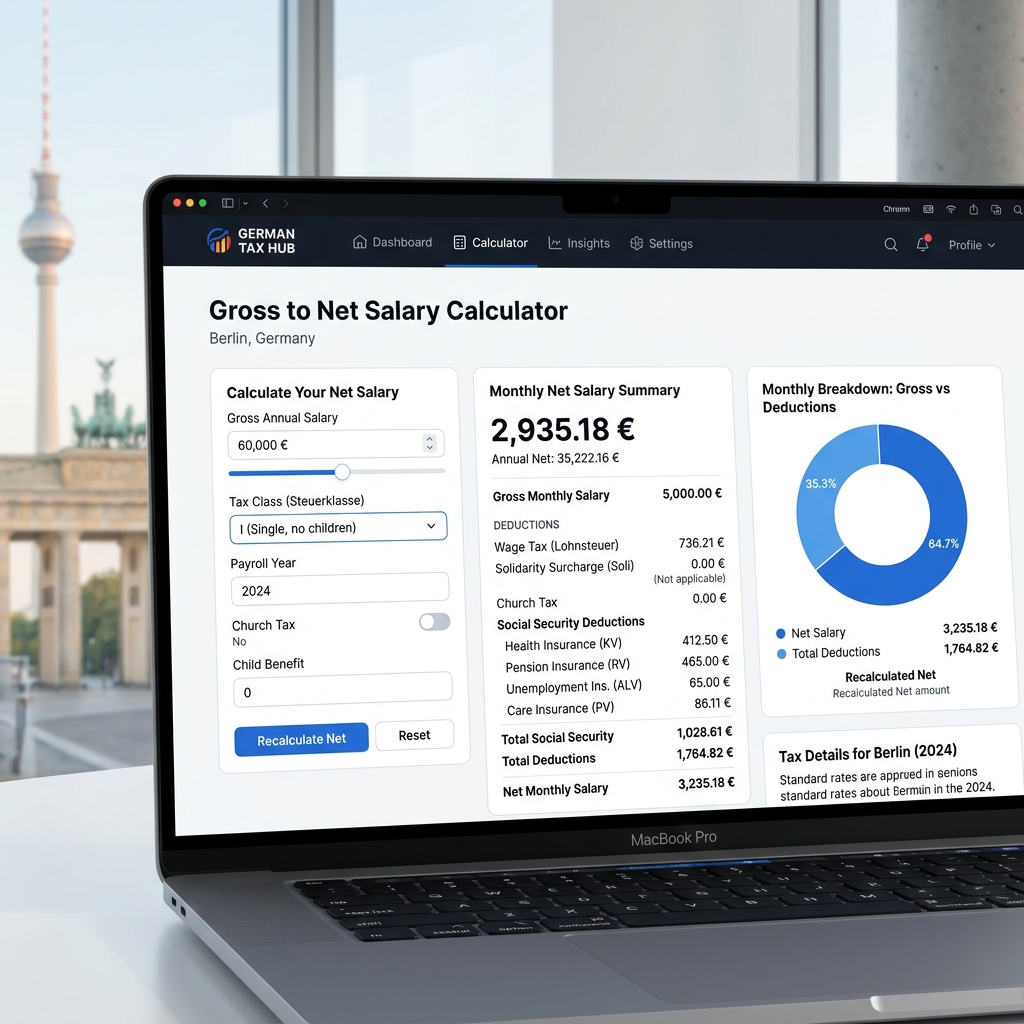
Here is exactly how a €60,000 gross salary breaks down on a Berlin payslip in 2026 for a single expat on Steuerklasse I with public health insurance and no church tax:
| Item | Monthly € | Rate | Notes for Berlin expats |
|---|---|---|---|
| Gross salary | €5,000 | — | Your starting point |
| Income tax (Lohnsteuer) | €1,010 | 20.2% | Largest deduction; Steuerklasse I assumed |
| Solidarity surcharge (Soli) | €0 | 0% | Abolished for most earners in 2026 |
| Pension insurance (RV) | €465 | 9.3% | Capped; employer matches this amount |
| Health insurance (KV) | €450 | 9.0% | Avg public insurer incl. 1.7% add. contribution |
| Unemployment ins. (AV) | €65 | 1.3% | Employer also pays 1.3% |
| Nursing care ins. (PV) | €85 | 1.7% | Add 0.6% if you have no children |
| Church tax (Kirchensteuer) | €0 | 0% | Only if registered; ~8% of your income tax |
| Total deductions | €2,075 | 38.1% | Net take-home: €2,925 / month |
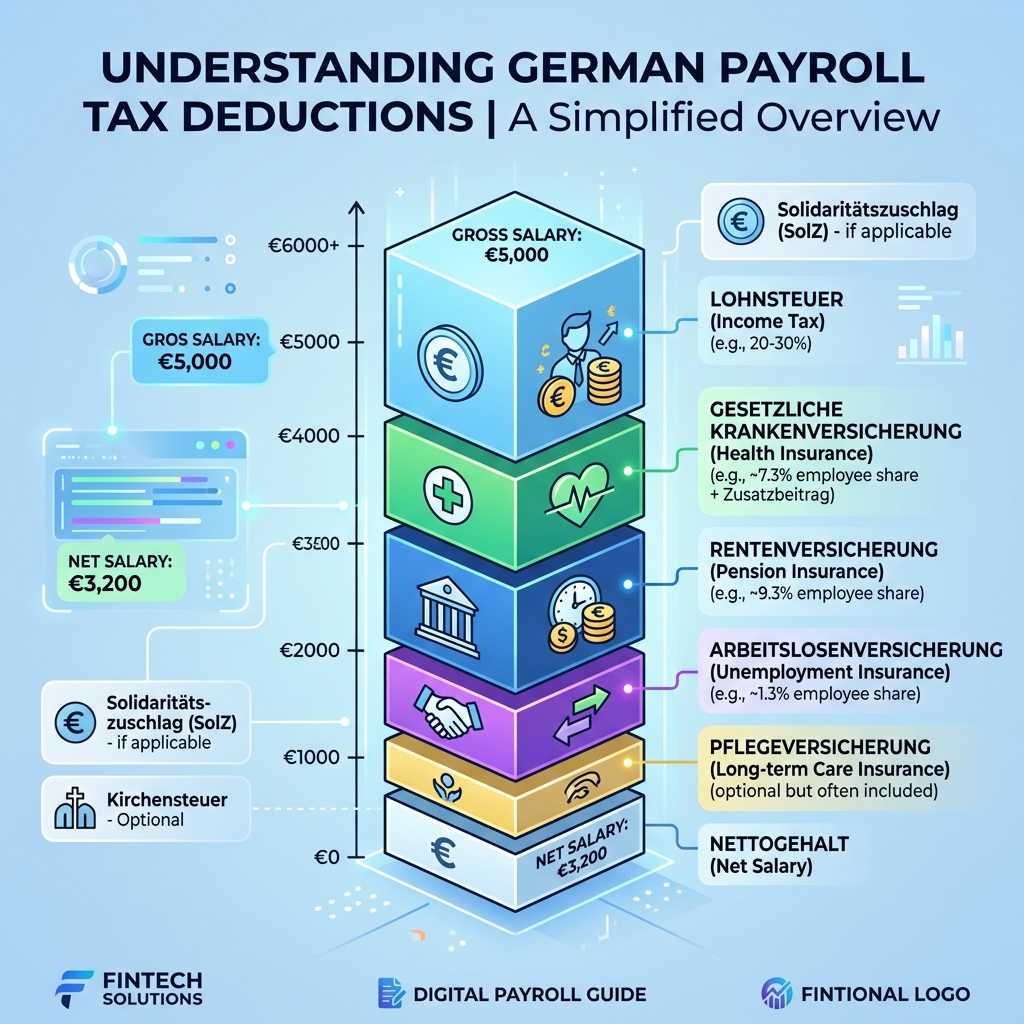
Bottom line: On a €60,000 gross salary in Berlin, you take home approximately €2,925 per month — or €35,100 per year. That is a total deduction rate of 38.1%. The biggest single variable you can change is your Steuerklasse — see Section 6 below.
Berlin vs other German cities: net salary and real disposable income
Berlin often surprises expats with a lower salary range than Munich or Frankfurt, but lower rents make the real disposable income competitive. Here is the full picture for a mid-to-senior professional across Germany's main tech and business hubs:
| City | Typical gross | Net/mo | Avg rent (1BR) | Disposable/mo |
|---|---|---|---|---|
| Berlin | €65k–€100k | €3,100–€4,000 | €1,100–€1,500 | €1,600–€2,500 |
| Munich | €80k–€120k | €3,400–€4,500 | €1,600–€2,000 | €1,400–€2,500 |
| Hamburg | €65k–€100k | €3,100–€3,900 | €1,200–€1,600 | €1,500–€2,300 |
| Frankfurt | €75k–€110k | €3,300–€4,200 | €1,300–€1,700 | €1,600–€2,500 |
| Stuttgart | €70k–€105k | €3,000–€4,000 | €1,000–€1,400 | €1,600–€2,600 |
| Cologne | €60k–€95k | €2,900–€3,800 | €900–€1,200 | €1,700–€2,600 |
The Berlin case: Berlin pays less gross than Munich or Frankfurt, but its rent is dramatically lower. A senior professional earning €85,000 gross in Berlin takes home ~€3,400/mo net and might pay €1,300 rent — leaving €2,100 disposable. The same person in Munich earns €100,000 gross, nets ~€4,000, but pays €1,900 rent — leaving the same €2,100 disposable. Berlin wins for quality of life per euro.
Steuerklasse in Berlin: which tax class should you choose?
Your Steuerklasse (tax class) is one of the most impactful decisions you can make regarding your monthly net salary. As a newly arrived expat in Berlin, you are automatically assigned Steuerklasse I. Here is what each class means and who should use it:
| Class | Who it applies to | What it means | Net/mo (€60k gross) |
|---|---|---|---|
| I | Single / divorced / widowed | Standard. Default for most expats arriving alone. | €3,095/mo |
| II | Single parent | Extra €4,260 allowance vs Class I. | €3,230/mo |
| III | Married — higher earner | Best net for the higher earner. Partner in Class V. | €3,550/mo (+€455) |
| IV | Married — equal earners | Both partners in IV; similar result to Class I. | €3,090/mo |
| V | Married — lower earner | High deductions; partner in Class III. | €2,580/mo |
| VI | Second job | Highest deductions; no basic allowance applied. | Lowest Net |
Action step for expat couples in Berlin: If you and your partner are both working in Germany and one earns significantly more, apply to switch to Steuerklasse III/V at your local Finanzamt Berlin. The higher earner moves to Class III and gains ~€300–500/mo net immediately. Do this within the first few months of arrival — it cannot be backdated further than the current calendar year.
What expats in Berlin often get wrong about German tax
1. Assuming the Solidaritätszuschlag (Soli) still applies
The solidarity surcharge — a flat 5.5% top-up on income tax — was effectively abolished for most earners from 2021 onwards and remains abolished in 2026. Only individuals with a very high income tax liability (above approximately €18,130 annual income tax) still pay it. For most expats in Berlin, Soli is €0.
2. Not claiming the home office deduction
Since 2020, German employees working from home can deduct €6 per home office day from their taxable income, up to €1,260 per year (210 days). If you work hybrid or remote, this is money on the table. Claim it in your annual Steuererklärung via ELSTER (Germany's free tax filing portal).
3. Not filing a tax return in the first year
Most expats arriving in Germany mid-year overpay income tax because the annual basic allowance (€12,096 in 2026) is applied in full but they only worked part of the year. Filing a Steuererklärung almost always results in a refund of €500–2,000 in your first year. It is not mandatory for employees, but it is almost always financially worth it.
4. Picking the wrong Krankenkasse
Germany's public health insurers (gesetzliche Krankenkassen) charge a standard rate of 14.6% (split equally between you and your employer) plus an additional contribution that varies by insurer, averaging 1.7% in 2026. Choosing a provider with a lower Zusatzbeitrag can save €15–40 per month. Compare current rates at gesetzlichekrankenkassen.de before you sign up.
5. Staying in church tax without realising it
If you were registered with a church in your home country and Germany sees this on your records, you may be charged Kirchensteuer automatically. Check your first Berlin payslip — if you see 'KiSt' as a deduction line and you are not actively a church member, visit a Berlin courthouse and file a Kirchenaustritt. It takes 20 minutes and stops the deduction from the following month.
New to Berlin? Your tax and admin checklist for the first 3 months
Getting your tax situation right in Germany requires completing several administrative steps in roughly the right order. Here is the timeline for a newly arrived expat in Berlin:
| When | Task | Where | Expat tip |
|---|---|---|---|
| Week 1–2 | Register address (Anmeldung) | Bürgeramt | Required for everything else. Book early — Berlin slots fill fast. |
| Week 2–3 | Get your Tax ID (Steuer-ID) | Auto-mailed post-Anmeldung | Arrives by post in 2–3 weeks. Keep it — needed for payroll. |
| Week 3–4 | Choose health insurer (Krankenkasse) | Your choice | Impacts your monthly deduction by €30–80. Compare before picking. |
| Week 4–6 | Open a German bank account | Deutsche Bank, N26, etc. | Required for salary payment. N26 or Revolut fastest for expats. |
| Month 2 | Register with Finanzamt if freelancing | Local Finanzamt | Get your Steuernummer. Required if invoicing clients. |
| Month 3+ | Review Steuerklasse | Finanzamt | If married or partnered — switching can mean +€300–500/mo net. |
| April–July | File Steuererklärung (tax return) | ELSTER or tax advisor | Most expats get a refund of €500–2,000 in their first year. |
Pro tip: Book your Bürgeramt (address registration) appointment the moment you know your Berlin address — slots regularly fill 3–5 weeks out. Without the Anmeldung you cannot get your Tax ID, cannot open a bank account with most providers, and your employer cannot process payroll correctly.
Berlin income tax calculator 2026 — model your exact salary
The fastest way to see your personal take-home pay is to use Paylio's Germany income tax calculator. Built specifically for expats in Germany, it calculates:
- Your monthly net salary after all deductions
- Income tax (Lohnsteuer) based on 2026 brackets
- All social contributions: health, pension, unemployment, nursing care
- Steuerklasse I through VI comparison
- Church tax on/off toggle
- Public vs private health insurance options
- Solidarity surcharge check (most users: €0)
- Annual take-home and employer cost
→ Use the Berlin income tax calculator now: paylio.com/germany-tax-calculator
Enter your gross salary, select Berlin / West Germany, choose your Steuerklasse, and see your full payslip breakdown instantly — no sign-up required.
Frequently asked questions — Berlin income tax 2026
How much income tax do you pay in Berlin in 2026?
Income tax in Berlin follows Germany's federal progressive brackets. On a €60,000 gross salary, a single expat pays approximately €1,010/month in income tax — an effective rate of around 20%. Total deductions including social contributions reach 38%. On €80,000 gross, the effective income tax rate rises to around 24%, with total deductions of approximately 41%.
Is Berlin a good city for expats financially?
Yes — Berlin has lower rents than Munich, Frankfurt, or Amsterdam, which means your real disposable income after housing is competitive despite lower headline salaries. A senior professional earning €85,000 gross in Berlin typically has €2,000–€2,500 disposable per month after tax and rent. The city also offers strong public services funded by those tax contributions: public transit, healthcare, and subsidised childcare.
Does moving from the UK to Berlin affect my income tax?
Yes significantly. The UK and Germany have a double taxation agreement, so you will not be taxed twice on the same income. Once you become a German tax resident (typically after 183 days in Germany), you pay German income tax on your worldwide income. Germany's rates are higher than the UK for mid-range earners but include contributions to a comprehensive social system. Use Paylio's Salary Comparison Tool to compare your net position in both countries.
What is the Steuerklasse for a single expat arriving in Berlin?
Single expats arriving in Berlin are automatically assigned Steuerklasse I (tax class one). This is the standard class for single individuals and applies the standard deduction allowances. If your status changes — you get married, have children, or your partner also starts working in Germany — you should review your Steuerklasse and update it at your local Finanzamt Berlin.
How do I file my German tax return as an expat in Berlin?
German tax returns (Steuererklärung) are filed via ELSTER, the free government online portal. Alternatively, you can use third-party English-language software. Most expats in their first German tax year get a refund and should file even if not legally required to. The filing deadline is 31 July of the following year.
Is €50,000 a good salary in Berlin?
€50,000 gross in Berlin gives you approximately €2,620 net per month after all deductions (Steuerklasse I, public health insurance). After rent for a one-bedroom apartment (€1,100–€1,400 in Berlin in 2026), you have €1,200–€1,500 disposable per month. This is a comfortable standard of living in Berlin, particularly compared to London or Paris at the same net figure, given Berlin's significantly lower cost of living.
Do I pay German tax on my foreign income while living in Berlin?
If you are a German tax resident (living in Germany for more than 183 days per year), Germany taxes your worldwide income — including income from abroad. However, Germany has double taxation agreements with most countries, so you typically receive a credit for tax already paid abroad. The rules are complex for multi-jurisdiction cases; a Steuerberater (German tax advisor) familiar with international tax is worth consulting in your first year.
Start calculating your Berlin net salary now
Stop estimating. Paylio's Berlin income tax calculator uses 2026 German tax rates to give you a precise monthly net salary figure — personalised to your Steuerklasse, health insurance, and gross salary. Free, instant, no sign-up needed.
→ Berlin income tax calculator 2026
Related guides: Germany Software Engineer Salary Calculator · Autónomo Spain Tax Calculator 2026 · Beckham Law Calculator 2026 · Compare Salaries Across Europe